Historic Residential Fabric
Federal, Victorian, Italianate, Romanesque, Colonial Revival, Beaux-Arts, Tudor, Georgian, Art Deco, Mid-Century, and contemporary architecture appear across the District.
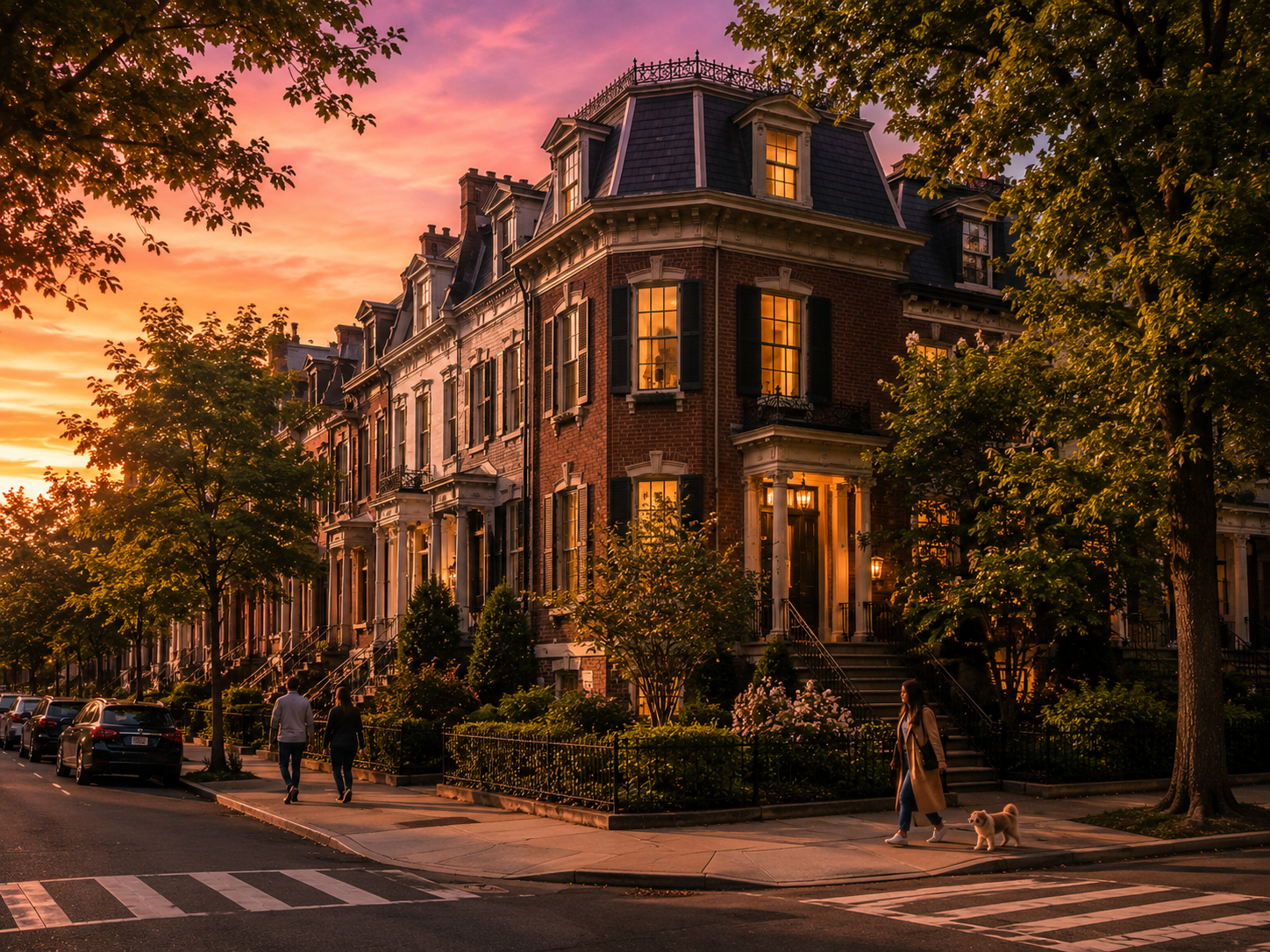
Washington, D.C. Community Guide
Historic architecture, international influence, distinguished residential neighborhoods, and a luxury market defined by property-specific and block-level differences.
The District of Columbia
Washington’s residential landscape reflects more than two centuries of civic planning, neighborhood growth, architectural experimentation, preservation, and international influence. Its broad avenues, circles, parks, rowhouse blocks, detached-home enclaves, apartment buildings, and embassy corridors create a market where every neighborhood—and often every street—must be understood on its own terms.
Federal, Victorian, Italianate, Romanesque, Colonial Revival, Beaux-Arts, Tudor, Georgian, Art Deco, Mid-Century, and contemporary architecture appear across the District.
Embassies, diplomatic residences, global institutions, universities, legal and policy centers, and international buyers contribute to Washington’s distinctive luxury market.
The market ranges from historic rowhouses and cooperative apartments to detached estates, contemporary homes, full-service condominiums, and private compounds.
City History
Washington’s urban form still reflects Pierre Charles L’Enfant’s original vision: a traditional street grid overlaid with diagonal avenues, circles, public spaces, and monumental vistas. Later planning, neighborhood development, transportation, parks, institutions, and preservation policies shaped the residential districts buyers recognize today.
The federal district was established and L’Enfant developed a plan organized around broad diagonal avenues, civic axes, a street grid, public squares, and connections between major government sites.
Rowhouse districts, commercial corridors, institutions, streetcar-linked communities, and detached-home neighborhoods expanded beyond the earliest core of the city.
The McMillan Commission renewed and extended the monumental planning tradition, influencing the Mall, parkways, public spaces, and the broader visual identity of the capital.
Beaux-Arts apartments, cooperative buildings, Art Deco residences, garden communities, postwar construction, and modern infill broadened the city’s housing stock.
Historic districts, sensitive renovations, adaptive reuse, luxury condominiums, and contemporary architecture now coexist within one of the country’s most architecturally layered residential markets.
Luxury Neighborhoods
The District’s luxury market is not one market. Each neighborhood has its own architecture, buyer profile, lot patterns, historic protections, walkability, privacy, inventory, and value drivers.
Federal and Victorian rowhouses, historic estates, cobblestone streets, waterfront access, boutiques, dining, university influence, and one of Washington’s most enduring luxury identities.
Grand residences, diplomatic properties, embassies, mature landscaping, architectural scale, and exceptional privacy near Embassy Row and Rock Creek Park.
Distinguished detached homes, embassy-area estates, quiet streets, substantial architecture, and limited inventory in a highly established Northwest setting.
Detached residences, larger lots, established landscaping, privacy, and a polished residential atmosphere near American University and Northwest amenities.
Understated luxury, green space, larger homes, mature trees, and convenient access to downtown, schools, trails, and Northwest institutions.
Historic detached homes, elegant apartment buildings, tree-lined streets, Metro access, Rock Creek Park, and a strong neighborhood center.
Classic detached homes, residential streets, parks, schools, and access to Connecticut Avenue and nearby Maryland amenities.
Historic townhouses, luxury condominiums, galleries, restaurants, Metro access, Embassy Row proximity, and sophisticated urban energy.
Federal, Italianate, Victorian, and Romanesque rowhouses, Eastern Market, parks, civic landmarks, and a strong historic neighborhood identity.
Wooded lots, detached homes, contemporary architecture, proximity to Rock Creek Park, and a quiet residential atmosphere in Northwest Washington.
Historic rowhouses, apartment residences, Metro access, proximity to Rock Creek Park, and convenient connections to Cleveland Park and Kalorama.
Established condominium and cooperative buildings, detached residences, landscaped grounds, and proximity to Wisconsin Avenue and the National Cathedral.
Distinctive brick residences, detached homes, quiet streets, nearby parks, and convenient access to Georgetown and the Potomac corridor.
A neighborhood atmosphere near the Potomac, detached homes, parks, trails, local businesses, and a strong residential identity.
Larger residences, wooded settings, privacy, access to MacArthur Boulevard, and highly sought-after locations near the western edge of the District.
A Market of Micro-Neighborhoods
Two homes with similar square footage may command very different values because of architectural integrity, block setting, lot orientation, parking, renovation quality, natural light, outdoor space, historic restrictions, views, schools, park access, and proximity to neighborhood amenities. Washington requires property-specific analysis rather than broad averages alone.
Residential Property Types
Property type affects valuation, inspections, renovation planning, financing, ownership costs, resale strategy, and the overall buying or selling process.
Federal, Italianate, Victorian, Romanesque, and Queen Anne residences with highly individual conditions, floor plans, additions, and renovation histories.
Single-family homes and estates where lot, setbacks, additions, landscaping, parking, privacy, and zoning can materially affect value.
New construction and established buildings with varying services, reserves, fees, parking, outdoor space, views, and resale profiles.
Distinct ownership structures requiring careful review of board requirements, financial statements, underlying obligations, rules, and transfer procedures.
Historic District Considerations
Washington contains numerous designated historic districts and landmarks. Exterior work may require additional review depending on the property and project. Buyers considering additions, window changes, masonry work, roof alterations, demolition, or visible exterior improvements should understand applicable standards, permits, prior approvals, and the condition of existing historic materials.
Buyer & Seller Advisory
Review structure, roof, masonry, windows, drainage, mechanical systems, prior alterations, permit history, and the quality of completed renovations.
Consider property taxes, insurance, utilities, maintenance, condominium or cooperative fees, reserves, assessments, landscaping, and long-term capital needs.
Evaluate scarcity, floor plan, natural light, lot, parking, outdoor space, architecture, street setting, and how future buyers may perceive the property.
Analyze financial statements, reserves, bylaws, insurance, pending projects, rental policies, fees, services, and the building’s competitive position.
Washington properties often require a carefully selected comparable set adjusted for block, architecture, renovation quality, parking, lot, views, and historic character.
Luxury sellers benefit from refined photography, editorial storytelling, strategic launch timing, targeted outreach, and the international platform of Sotheby’s International Realty.
Daniel William Hynes
Daniel’s long-standing connection to Washington, more than 35 years of real estate experience, over $400 million in career sales, and affiliation with TTR Sotheby’s International Realty support a discreet and highly informed advisory experience for buyers, sellers, investors, and referral clients.
Local Market Perspective
Washington, D.C. offers one of the country’s most distinctive luxury residential markets. Buyers can choose among historic Georgetown rowhouses, Kalorama estates, embassy-area residences in Massachusetts Avenue Heights, detached homes in Spring Valley and Wesley Heights, classic properties in Cleveland Park and Chevy Chase DC, condominiums near Dupont Circle and Cathedral Heights, and historic homes throughout Capitol Hill.
Northwest Washington also includes highly desirable residential markets such as Forest Hills, Woodley Park, Foxhall, Berkley, Kent, Palisades, and Observatory Circle. These areas differ in lot size, housing style, privacy, walkability, park access, school proximity, retail, transportation, renovation history, and available inventory. Accurate representation requires neighborhood-specific and property-specific analysis.
Daniel William Hynes provides Washington DC buyers and sellers with local knowledge, strategic negotiation, thoughtful valuation, discreet representation, and access to the global Sotheby’s International Realty network. Whether the objective is acquiring a historic residence, selling a significant estate, evaluating a condominium, relocating to the capital region, or planning a future renovation, each decision is approached with care and long-term perspective.
Guidance based on architecture, property type, block setting, historic status, inventory, and recent market activity.
Planning, valuation, negotiation, due diligence, and transaction management from consultation through closing.
Refined presentation, professional imagery, editorial storytelling, targeted exposure, and global distribution.
Advice informed by future marketability, renovation potential, scarcity, ownership goals, and lasting value.
Washington DC Real Estate FAQ
Washington offers Federal and Victorian rowhouses, embassy-area estates, detached residences, historic mansions, contemporary homes, luxury condominiums, cooperative apartments, and private compounds. The available property mix varies significantly by neighborhood.
Prominent luxury markets include Georgetown, Kalorama, Massachusetts Avenue Heights, Spring Valley, Wesley Heights, Cleveland Park, Chevy Chase DC, Forest Hills, Woodley Park, Cathedral Heights, Foxhall, Berkley, Kent, Palisades, Dupont Circle, and Capitol Hill.
Historic designation may affect exterior alterations, additions, demolition, windows, masonry, roofing, and other visible work. Buyers planning renovations should review applicable standards, existing permits, prior approvals, and professional recommendations before purchasing.
Architecture, lot, street setting, parking, natural light, outdoor space, views, renovation quality, historic status, park access, retail, schools, and scarcity can all influence value. Broad neighborhood averages rarely capture the full picture.
Review governing documents, financial statements, reserves, insurance, fees, pending projects, assessments, rental policies, pet rules, parking, storage, board requirements, transfer procedures, and the building’s resale history.